
BPI Seminar by Dr. Michael Cunningham
May 15, 2026, 2:00 pm to 3:00 pm
Carbon Dioxide Responsive Polymers: Design, Properties & Applications
Location: CHBE #202, 2360 East Mall Vancouver BC V6T 1Z4
Agenda
- 2:00 PM Introduction by Dr. Emily Cranston
- 2:05 PM Presentation by Dr. Michael Cunningham, Professor, Department of Chemical Engineering, Queen's University
- 2:45 PM Q&A
*Light refreshments will be provided.
Abstract
Carbon dioxide responsive polymers undergo reversible changes in properties upon addition or removal of atmospheric pressure CO2, making them potentially suitable for a wide variety of practical applications with key advantages compared to existing stimuli responsive polymers, including the use of CO2 as a benign, nontoxic and inexpensive trigger. While a range of different functional groups can be utilized to impart CO2 responsiveness, tertiary amines and amidines are the most commonly used. As shown in Figure 1, tertiary amine containing polymers can be reversibly switched from being hydrophobic (water-insoluble) to hydrophilic (water-soluble) by exposure to, or removal of, CO2 as a result of the protonation/deprotonation of the nitrogen atoms accompanying a change in pH. CO2 is easily added by sparging gaseous CO2 into any system, and is easily removed by sparging with air, nitrogen or any nonacidic gas. A notable advantage of CO2 responsivepolymers is that there is no accumulation of stimuli (or byproducts) in the system with each reversible cycle. In contrast, when liquid acids and bases are used with pH responsive materials, salt accumulates with each cycle. This lecture will present the principles of CO2 switching, and in particular the importance of selecting the correct basicity and concentration of the switchable groups to ensure effective changes in product properties for a given application. We have designed CO2 responsivepolymers for a range of applications, including switchable nanoparticles, switchable viscosity solutions, switchable surfaces (Figure 2), switchable hydrogels, switchable coatings, and as draw agents for forward osmosis water purification.

Figure 1. Polymers containing tertiary amines are hydrophobic when in their neutral state (left) but in the presence of water and CO2 (1 bar) become charged and hydrophilic (right). The loss of CO2 (e.g. evaporation, sparging with air/nitrogen/argon) results in the polymer reverting to its hydrophobic state.
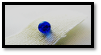

Figure 2. Water drop on linen coated with a CO2 responsive polymer, with the polymer in either its hydrophobic (left) or hydrophilic (right) state.
About the Speaker
Michael Cunningham is a Professor in Chemical Engineering at Queen’s University where he holds the Donald and Sarah Munro Research Chair. His research program focusses on the development of novel polymer nanoparticles, CO2-switchable polymers, and sustainably-sourced polymeric materials including hybrids of synthetic polymers and renewable polymers. He is Chair of the International Polymer Colloids Group and recipient of several national research awards including the NSERC Brockhouse Canada Prize for Interdisciplinary Research in Science and Engineering, Macromolecular Science and Engineering Award, Canadian Green Chemistry and Engineering Award, and the Syncrude Canada Innovation Award, as well as the Queen’s University Prize for Excellence in Research and the Professional Engineer’s Ontario Research and Development Medal. He is a Fellow of the Chemical Institute of Canada, Canadian Academy of Engineering, Engineering Institute of Canada and Royal Society of Chemistry (UK).